Thirteen Villages & One Goal...
Newtonville: A Greenway to Reunite the Village
Newtonville was Beautiful Newtonville
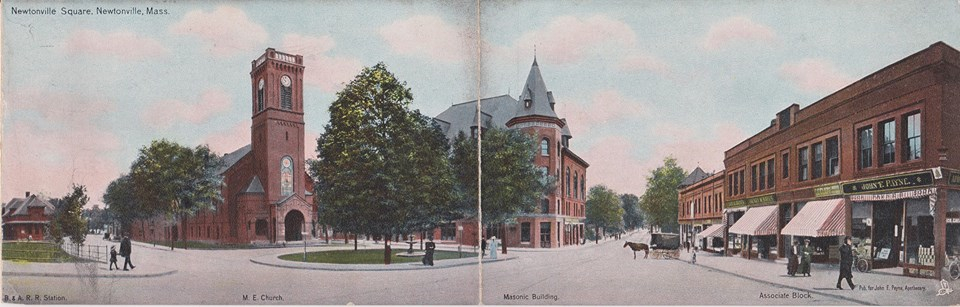
Until the Mass Pike extension bulldozed through in 1962, Newtonville had a predominantly Victorian architectural aesthetic that was as coherent as Waban's Tudor Revival look still is today. This historic postcard, with its charmingly skewed attempt at giving a panoramic perspective, gives a sense of how handsome Newtonville once was, and could be again. At the far left is the stately railroad station, with its accessible ramps down to the platforms. Next is the brick Methodist Church, today clad in gray stone and having a much less attractive top to its steeple. Next is the Masonic Building, thankfully, still intact today, then a view looking south down Walnut Street. The southmost brick storefronts are today single-story brick storefronts. The brick block at the extreme right was demolished, and stands approximately where the Austin Street storefronts and the Star Market parking lot are today.
Until the Mass Pike extension bulldozed through in 1962, Newtonville had a predominantly Victorian architectural aesthetic that was as coherent as Waban's Tudor Revival look still is today. This historic postcard, with its charmingly skewed attempt at giving a panoramic perspective, gives a sense of how handsome Newtonville once was, and could be again. At the far left is the stately railroad station, with its accessible ramps down to the platforms. Next is the brick Methodist Church, today clad in gray stone and having a much less attractive top to its steeple. Next is the Masonic Building, thankfully, still intact today, then a view looking south down Walnut Street. The southmost brick storefronts are today single-story brick storefronts. The brick block at the extreme right was demolished, and stands approximately where the Austin Street storefronts and the Star Market parking lot are today.
The Railroad Give & Take
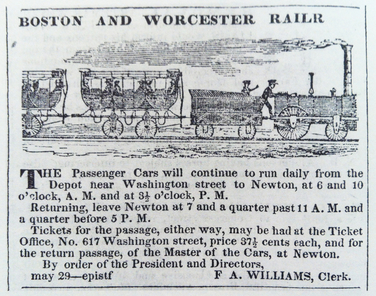
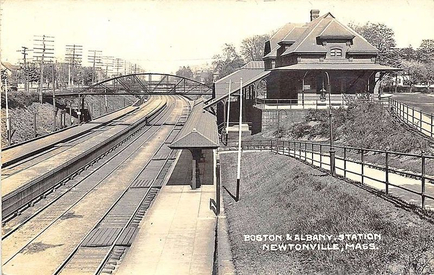
The Boston and Worcester Railroad (later Boston and Albany) arrived in Newtonville in 1834, making Newtonville village center a bustling place of commerce for nearby farmers, and encouraging affluent Bostonians to build large summer homes nearby. Over time these Victorian houses became the homes of people increasingly able to live in the leafy splendor of the Garden City while commuting on faster trains to work on Boston. Newtonville had a beautiful railroad station, with ramps making the platforms accessible. Today, the southernmost lanes of the Mass Pike are situated below where the magnificent station house once stood.
The Boston and Worcester Railroad (later Boston and Albany) arrived in Newtonville in 1834, making Newtonville village center a bustling place of commerce for nearby farmers, and encouraging affluent Bostonians to build large summer homes nearby. Over time these Victorian houses became the homes of people increasingly able to live in the leafy splendor of the Garden City while commuting on faster trains to work on Boston. Newtonville had a beautiful railroad station, with ramps making the platforms accessible. Today, the southernmost lanes of the Mass Pike are situated below where the magnificent station house once stood.
|
|
The Massachusetts Turnpike Extension
Despite the intense opposition of Newton residents, and the valiant, but futile, attempts of Newton's mayor to change the route, the powerful Massachusetts Turnpike Authority (MTA) was determined to extend the Mass Turnpike into Boston, through Newton. The railroad had long bisected Newtonville, but the Turnpike split it further apart, like an open wound. The MTA took hundreds of homes and business properties by eminent domain, provoking bitterness that lasts to this day. The MTA’s air rights deal in Newtonville resulted in the rebuilding of the Star Market, which was very welcome, although the market's Brutalist-style architecture was a blow to the architectural harmony of Newtonville's mostly Victorian ambiance.
Despite the intense opposition of Newton residents, and the valiant, but futile, attempts of Newton's mayor to change the route, the powerful Massachusetts Turnpike Authority (MTA) was determined to extend the Mass Turnpike into Boston, through Newton. The railroad had long bisected Newtonville, but the Turnpike split it further apart, like an open wound. The MTA took hundreds of homes and business properties by eminent domain, provoking bitterness that lasts to this day. The MTA’s air rights deal in Newtonville resulted in the rebuilding of the Star Market, which was very welcome, although the market's Brutalist-style architecture was a blow to the architectural harmony of Newtonville's mostly Victorian ambiance.
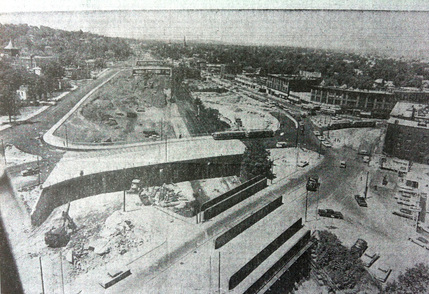
Mass Pike extension construction, from Newton Corner towards Newtonville.
|
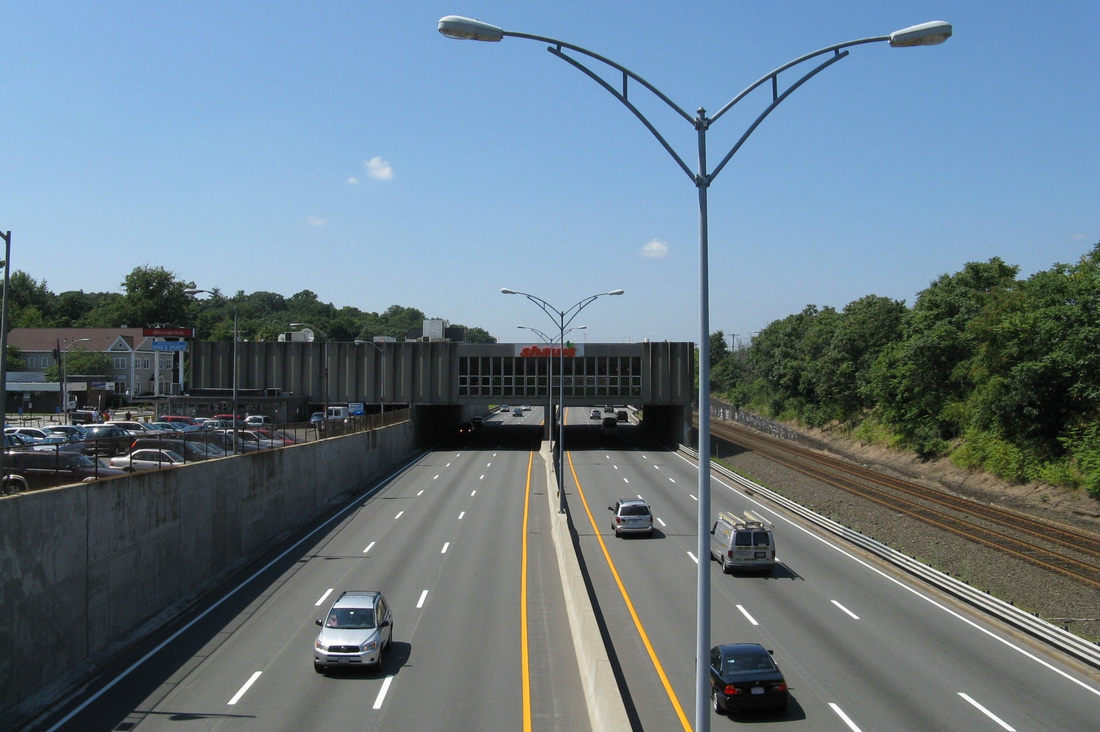
Shaw's, now Star Market, built over Mass Pike. Photo, John Phelan.
|
Visions for Reuniting Newtonville
Newtonville residents, understandably, dislike walking across the Walnut Street bridge over the highway and train tracks. The walk is a scorching, tree-less trek in the summer, and akin to traversing an arctic wind tunnel in the winter. The highway is incredibly noisy, and auto emissions float up into the vibrant village center. The beautiful old station house is long gone, replaced by a scary, flimsy-looking staircase leading down to (thus not-accessible) railroad platforms below. It's no wonder residents, architects and planners have long dreamed of decking over the highway and tracks to recreate Newtonviile's village green. A number of people have offered sketches of such a plan in recent years, but perhaps the best known sketches come from a charrette done in 2008 by architecture graduate student interns from the well-known Sasaki Associates design firm. Some of their ideas were youthful, and impractical, like the anthill-style train station with a gigantic video screen, and the exterior "living walls" of new buildings, that would almost certainly not survive a typical New England winter (below).
Newtonville residents, understandably, dislike walking across the Walnut Street bridge over the highway and train tracks. The walk is a scorching, tree-less trek in the summer, and akin to traversing an arctic wind tunnel in the winter. The highway is incredibly noisy, and auto emissions float up into the vibrant village center. The beautiful old station house is long gone, replaced by a scary, flimsy-looking staircase leading down to (thus not-accessible) railroad platforms below. It's no wonder residents, architects and planners have long dreamed of decking over the highway and tracks to recreate Newtonviile's village green. A number of people have offered sketches of such a plan in recent years, but perhaps the best known sketches come from a charrette done in 2008 by architecture graduate student interns from the well-known Sasaki Associates design firm. Some of their ideas were youthful, and impractical, like the anthill-style train station with a gigantic video screen, and the exterior "living walls" of new buildings, that would almost certainly not survive a typical New England winter (below).
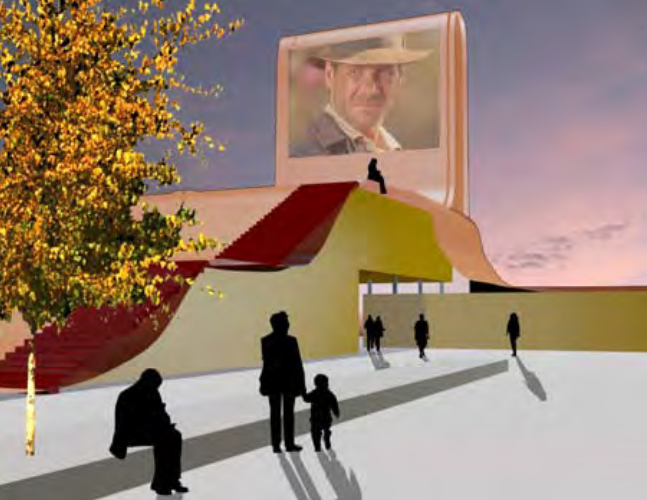
Proposed Newtonville train station. Source, Sasaki Charrette.
|
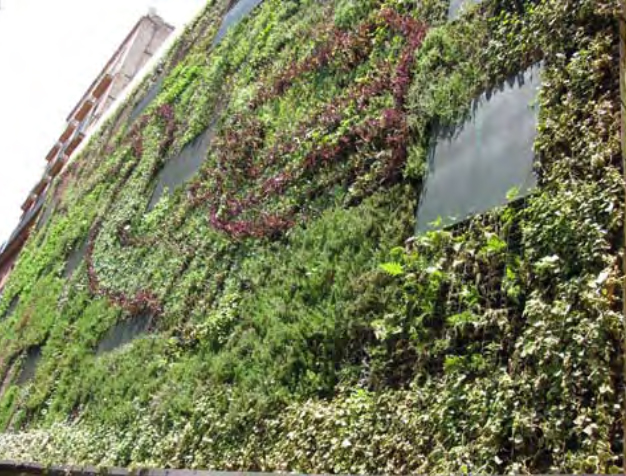
Proposed living walls for exterior of new buildings on Newtonville deck. Source, Sasaki Charrette.
|
Although some of their more fanciful prescriptions for fixing the problem of a severed village were not realistic, their analysis of the problem was very insightful. View the Sasaki Charrette Parts 1, 2 and 3. Their sketch (below) illustrates one of the complicating factors in creating a decking structure. The height required to allow trains to pass underneath is the reason the Walnut Street bridge arches up, and the reason a deck will probably need to incorporate ramps, steps and terraced levels to accommodate the trains underneath as well. Technology has advanced and the costs associated with building air rights decks have fallen, so reuniting Newtonville is possible and affordable. However, the cost of depressing the railroad tracks further to allow for a completely level deck is prohibitive, so a completely level deck may not be possible. It should be explored fully, however, as it would be optimal.
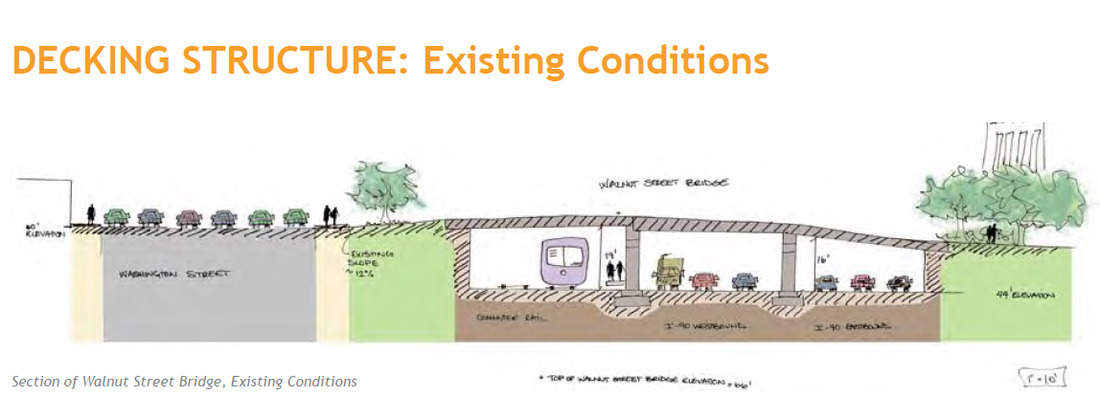
Decking to reunite Newtonville's village center. Source, Sasaki Charrette.
The Ted Kennedy Greenway
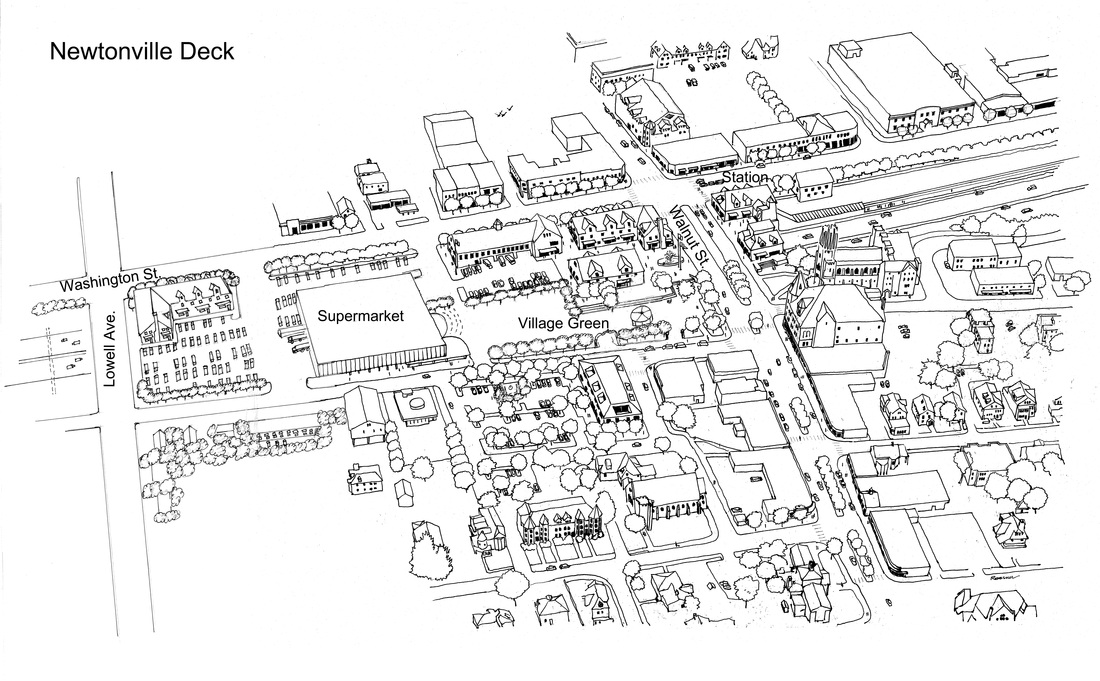
In 2014, a Newtonville resident proposed the idea of building a deck over the Turnpike and the commuter rail tracks from just east of Walnut Street to Lowell Avenue to create a “Ted Kennedy Greenway” in honor of the distinguished late U.S. senator. A small committee of residents has been researching this idea. The final plan for what a Ted Kennedy Greenway would look like would need to be negotiated between the public and private participants, the people of Newtonville and their representatives on the City Council and the Newtonville Area Council. The greenway sketch below is simply a draft plan, not a final plan.
The good news is that the technology for air rights projects has advanced and the cost is directly related to the weight of what goes on the deck. So if what’s on the deck is a beautiful village green, some appropriate buildings of two or three stories for high-skills employers, retail and senior/affordable housing, and re-positioned, tree-lined parking lots for the village and for a refreshed Star Market, the cost would be low enough to be manageable in a public-private partnership. No looming concrete tower is required to make this work financially. Now elected officials and the private sector are discussing this idea, and support is growing. It could be a win-win for residents, City Hall, and the public and private participants.
The vision for decking over the Turnpike and track from just east of Walnut Street to Lowell Ave includes the creation of a Richardson-style (like the Green Line “T” station houses elsewhere in Newton) commuter rail station building with an elevator down to an improved rail platform, creating at steet-level a plaza with a decorative fountain. This plaza would enliven the east side of Walnut Street, perhaps encouraging a new upscale restaurant to move into the vacant street-level restaurant space and garden in the Methodist church-turned-office building across Walnut Street from the current Star Market parking lot. That parking lot would be moved to the other side of the supermarket and north onto the new "land" created by the decking. The current supermarket parking lot would, hopefully, become the village green. Below is a sketch based on an earlier drawing by the distinguished Newton architect William Roesner.
In 2014, a Newtonville resident proposed the idea of building a deck over the Turnpike and the commuter rail tracks from just east of Walnut Street to Lowell Avenue to create a “Ted Kennedy Greenway” in honor of the distinguished late U.S. senator. A small committee of residents has been researching this idea. The final plan for what a Ted Kennedy Greenway would look like would need to be negotiated between the public and private participants, the people of Newtonville and their representatives on the City Council and the Newtonville Area Council. The greenway sketch below is simply a draft plan, not a final plan.
The good news is that the technology for air rights projects has advanced and the cost is directly related to the weight of what goes on the deck. So if what’s on the deck is a beautiful village green, some appropriate buildings of two or three stories for high-skills employers, retail and senior/affordable housing, and re-positioned, tree-lined parking lots for the village and for a refreshed Star Market, the cost would be low enough to be manageable in a public-private partnership. No looming concrete tower is required to make this work financially. Now elected officials and the private sector are discussing this idea, and support is growing. It could be a win-win for residents, City Hall, and the public and private participants.
The vision for decking over the Turnpike and track from just east of Walnut Street to Lowell Ave includes the creation of a Richardson-style (like the Green Line “T” station houses elsewhere in Newton) commuter rail station building with an elevator down to an improved rail platform, creating at steet-level a plaza with a decorative fountain. This plaza would enliven the east side of Walnut Street, perhaps encouraging a new upscale restaurant to move into the vacant street-level restaurant space and garden in the Methodist church-turned-office building across Walnut Street from the current Star Market parking lot. That parking lot would be moved to the other side of the supermarket and north onto the new "land" created by the decking. The current supermarket parking lot would, hopefully, become the village green. Below is a sketch based on an earlier drawing by the distinguished Newton architect William Roesner.
Why the Deck Makes Sense Right Now
Many in Newtonville are worried about the impact on all village businesses of the construction process for the Austin Street Partners development. Now Robert Korff of Mark Investment has presented a plan to raze all the structures along Washington Street on the north side of the Mass Pike in Newtonville from Walnut Street to Washington Terrace (and, he indicated, to Lowell Avenue, pending his current negotiations to buy more buildings). This is the stretch of Washington Street directly across from Star Market and the Austin Street parking lot. Whatever the final version each of these projects takes, if they are built , both sides of the Turnpike in Newtonville are going to become a massive construction zone for the better part of two years. It makes sense to build the deck and the Ted Kennedy Greenway at the same time, and overcome the trauma on residents and businesses by coming out at the other end with something wonderful, beautiful, great for the public, and advantageous for public and private entities that participated in making it happen. Residents and businesses displaced by the Austin Street Partners and Mark Investment projects must receive compensation from the developers sufficient to allow them to rebuild their lives and their businesses again, preferably in Newtonville.
Many in Newtonville are worried about the impact on all village businesses of the construction process for the Austin Street Partners development. Now Robert Korff of Mark Investment has presented a plan to raze all the structures along Washington Street on the north side of the Mass Pike in Newtonville from Walnut Street to Washington Terrace (and, he indicated, to Lowell Avenue, pending his current negotiations to buy more buildings). This is the stretch of Washington Street directly across from Star Market and the Austin Street parking lot. Whatever the final version each of these projects takes, if they are built , both sides of the Turnpike in Newtonville are going to become a massive construction zone for the better part of two years. It makes sense to build the deck and the Ted Kennedy Greenway at the same time, and overcome the trauma on residents and businesses by coming out at the other end with something wonderful, beautiful, great for the public, and advantageous for public and private entities that participated in making it happen. Residents and businesses displaced by the Austin Street Partners and Mark Investment projects must receive compensation from the developers sufficient to allow them to rebuild their lives and their businesses again, preferably in Newtonville.
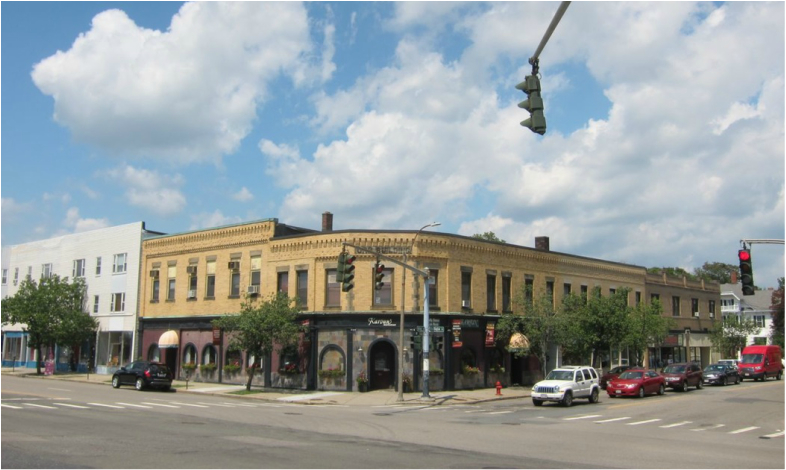
The Orr Block, at the corner of Washington and Walnut.
|
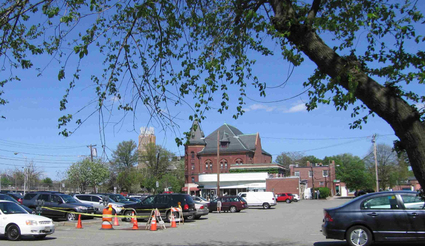
Austin Street public parking lot.
|
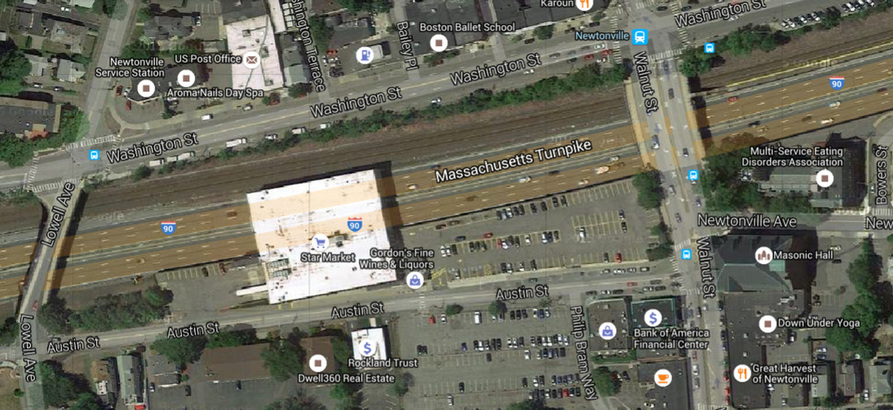
Potential construction sites from Lowell to Walnut on the north, and on Austin Street parking lot site to the south. Source, Google Street View.